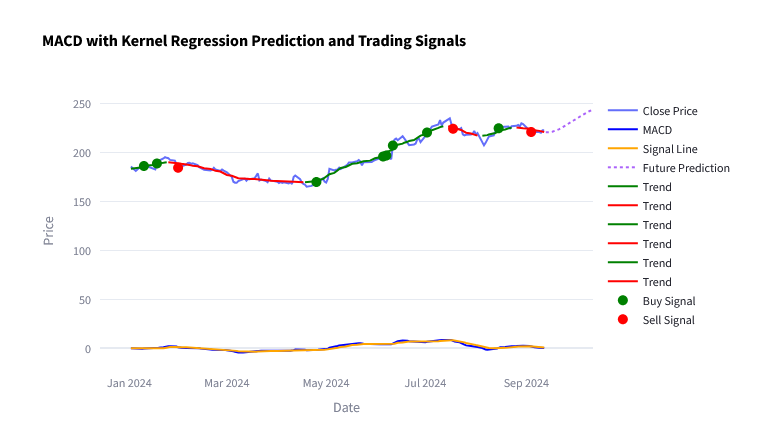
10 Suggestions To Help You Evaluate The Trade’s Costs And The Timing For Execution When Using An Ai Stock Trade Forecaster
The trading costs and timing of execution are vital to evaluate the ability of a predictor for stock trading. They directly impact profits. Here are 10 tips to help you analyze these factors.
1. Analyze the effect of transaction cost on profitability
What is the reason? The costs of trading, such as commissions, slippage and fees could cause returns to be diminished, especially when trading high-frequency.
What to do: Ensure that the model is inclusive of all trading costs when calculating its profits. Effective predictors mimic the real-world costs of trading to provide real-time performance metrics.
2. Evaluation of the Model’s resistance to slippage
Slippage – the difference in price between the date you place an order, and when it’s completed – can adversely affect the profits.
What should you do: Be sure to include slippage estimates in the model based on market liquidity and orders size. Models that dynamically adjust slippage are better equipped to predict real returns.
3. Review the Frequency of trades in relation to the expected Returns
Why: Frequent trading leads to higher transaction costs, which can reduce net profit.
How: Determine whether the model’s trading frequency is backed by returns. Models that maximise trading frequency balance gains and losses while maximizing net profit.
4. Be sure to consider the impact of market conditions for large trades
The reason: Large trades may change the market price, which can increase the price of execution.
How to verify that the model is taking into consideration the impact on markets of large-scale orders. This is crucial, particularly if they target high liquidity stocks. Market impact modeling prevents underestimating the profits of large trades.
5. Examine the time-in-force settings and trade flexibility
The reason is that time-inforce settings (like Immediate Cancel and Good Till Cancelled), affect the execution of trades.
How to verify that the model uses proper time-in-force settings for its strategy, allowing it to trade in the event of favorable conditions without causing excessive time delays.
6. Evaluation of latency and its impact on execution time
Why? In high-frequency trading the high latency (the delay between signal generation and execution of trades) can lead to missed opportunities.
What can you do to ensure that the model is designed to execute with low latency or includes possible delays. In high-frequency strategies, accuracy and profit depend on minimizing the amount of latency.
7. Seek out monitoring of execution in real-time.
Why: Monitoring execution in real-time assures that transactions are completed at prices anticipated, minimizing adverse timing effects.
What should you do? Confirm that the model has real-time monitoring for trades in order to prevent execution at a disadvantageous price. This is crucial for volatile assets or strategies that rely on a precise timing.
8. Confirm Smart Routing to ensure the best Execution
What is the reason? Smart Order Routing (SOR) algorithms determine the most efficient locations for order execution. They improve prices and decrease costs.
How to: Make sure the model simulates or utilizes SOR to increase fill rates and minimize slippage. SOR aids in ensuring that the model is executed with a better cost, by considering various exchanges, liquidity pools and other aspects.
Review the inclusion costs of the Bid-Ask Spread
Why: The spread between the bid and asking price, in particular in stocks with lower liquidity, is a trade cost directly affecting profit.
How: Check that the model takes into account bid-ask cost spreads. If not this could result in understating expected returns. It is essential to check this for models that are trading on illiquid or smaller markets.
10. Determine performance metrics following delays in accounting execution
What’s the reason? The accounting for delays in execution provides a more realistic view of the model’s performance.
How do you determine if the indicators such as Sharpe ratios or returns have been adjusted to account for execution delays. Models which take into consideration timing effects can provide more precise performance evaluations.
If you take the time to review these elements it will be easier to understand how an AI trading predictor is able to manage the costs of trading and timing issues making sure that its profit estimates are realistic and achievable in the real world of market conditions. Take a look at the top on the main page on ai trading for blog recommendations including ai stock market, ai for stock trading, ai for stock trading, ai for stock market, ai stock market, ai stock investing, stock prediction website, best stocks in ai, artificial intelligence stocks, buy stocks and more.
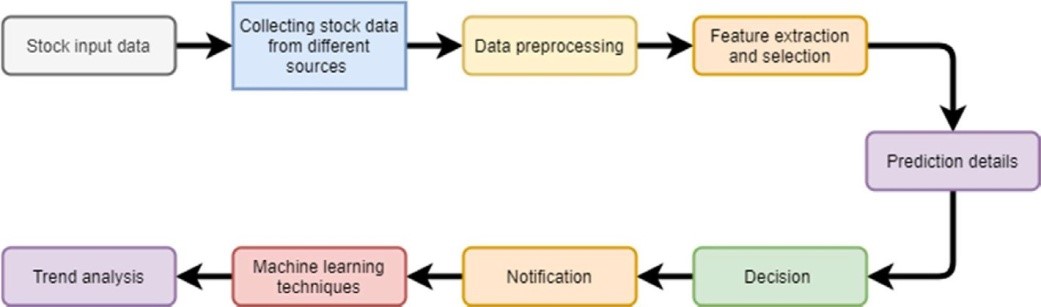
Ten Top Tips For Assessing Amd Stock Using An Ai-Powered Prediction Of Stock Trades
In order for an AI-based stock market predictor to be effective, AMD stock must be evaluated by understanding its product portfolio, market dynamics, competitive landscape and its company’s products. Here are ten tips on how to evaluate AMD stock by using an AI model.
1. Understand AMD Business Segments
Why: AMD is a semiconductor firm which manufactures CPUs, GPUs and other hardware that is used in various applications such as gaming, data centres, and embedded systems.
How to: Get familiar with AMD’s primary products and revenue sources as well as growth strategies. This can help the AI predict performance using segments-specific trending.
2. Integrates Industry Trends and Competitive Analysis
What is the reason AMD’s performance is dependent on trends in the semiconductor sector and competition from companies such as Intel and NVIDIA.
How do you ensure that the AI model analyses industry trends like shifts in market demand for gaming equipment, AI applications and data center technology. AMD’s position in the market will be affected by an analysis of the competition landscape.
3. Earnings Reports The Critical Analysis
Earnings announcements play a significant influence on the price of stocks particularly in the tech industry. Expectations for growth are high.
How do you monitor AMD’s annual earnings calendar, and look at previous earnings surprises. Integrate the future guidance of AMD and market analyst forecasts into your model.
4. Utilize technical analysis indicators
Technical indicators can be used to determine trends in the prices and the momentum of AMD’s stock.
How to: Incorporate indicators like moving-averages, Relative Strength Index RSI and MACD(Moving Average Convergence Differenciation) in the AI model to determine the best places to enter and exit.
5. Analyze Macroeconomic Aspects
What’s the reason? Economic conditions, such as inflation, interest rates, as well as consumer spending may affect demand for AMD’s products.
How to: Include relevant macroeconomic indicator in the model, for example the growth in GDP, unemployment rate and performance of the tech industry. These variables can give important background when studying the performance of a stock.
6. Analyze Implement Sentiment
The reason: Market sentiment is among the primary factors that can influence the price of stocks. This holds true especially for technology stocks, as the perceptions of investors play a major part.
What can you do: You can employ sentiment analysis to assess the opinions of investors and public on AMD through analyzing social media articles, posts in news publications, and tech forums. These qualitative data could be utilized to inform the AI model.
7. Monitor Technology-related Developments
The reason: Rapid advances in technology could impact AMD’s performance and growth in the future.
How: Stay current on the latest product releases and technological advancements. When you predict future performance, ensure that the model incorporates these changes.
8. Conduct backtesting using Historical Data
Why is it important to backtest? It helps confirm the accuracy of the AI model could have performed based on historical price movements and major events.
How to use historic stock data for AMD to test model predictions. Compare predicted and actual outcomes to assess the accuracy of the model.
9. Measure execution metrics in real-time
What’s the reason? The efficient execution of trades is crucial for AMD to profit from price movements.
Check execution metrics like the rate of fill and slippage. Check how AMD’s stock can be traded by using the AI model to determine the optimal exit and entry points.
Review risk management and position sizing strategies
The reason: Effective risk management is vital to safeguard capital in volatile stocks like AMD.
How: Ensure your model includes strategies for position sizing and risk management based upon AMD’s volatility, as well as your overall portfolio risk. This will allow you to minimize losses while maximising return.
Check these points to determine the AI trading predictorâs capabilities in analysing and predicting movements of AMD’s stock. This ensures that it remains accurate and current in evolving market conditions. See the recommended best stocks in ai examples for blog advice including ai penny stocks, ai stock investing, investment in share market, buy stocks, market stock investment, ai stock price, chart stocks, ai trading software, best stocks in ai, trading ai and more.